My Favorite Books
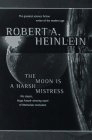
The Moon is a Harsh Mistress by Robert A. Heinlein
Some books surprise me by being a lot more deep than I had expected, and this books did that more than any other. I started reading it thinking it was scifi/mystery set on the moon, while in actuality it's more like a manual for staging a libertarian revolution. Heinlein's books seem to fall into two categories, and this one definitely is in the category of communicating his political views (instead of the category of communicating his sexual opinions). Whether or not his political systems make practical sense, they are interesting just because they are so different from what you hear today. Another of this books, Starship Troopers seems to espouse fascism, in the guise of a military scifi adventure. I would steer clear of some of his books (To Sail Across the Sunset comes to mind), but his more political ones are all great.See Also:
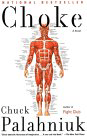
Choke by Chuck Palahniuk
All of his books are great, in a sort of anarchist/libertarian way, but this one is my favorite. Really weird things go on through the entire book, and the main character just takes them in stride. It definitely makes my life look much more normal. The beginning has an interesting take on the relationship between a choking victim and the person that saves them. Among his other books, Fight Club is definitely worth a read. The movie followed the plotline pretty closely, but the book goes into much more detail as to why they wanted to bring us back into the stone age.See Also:

Neuromancer by William Gibson
This is the only book ever to have won the Hugo, the Nebula, and the Philip K. Dick science fiction awards. There is a reason for this. It's short, exciting, and predicted the internet 20 years before anyone had ever come up with the idea of a global network. The two other books in this trilogy, and his book of short stories, Burning Chrome, are all just as good. It is one of the grittiest, most realist scifi books I've ever read, and Gibson is very much the father of cyberpunk. The big, overall story that is contained in the Neuromancer trilogy is pretty amazing, and the ending is worth the read just by itself. Also see his newest one, Pattern Recognition. Not set in the future like the others, but still incredibly good, and proof that he can write just as well while set in the present.See Also:

Sunrunner's Fire by Melanie Rawn
I first read this book my freshman year at UF, and I've gone back and read the whole six book series twice since then. This book is third in the series, and probably my favorite, but any of the others could have been here instead; there isn't a low point, or a bad middle book you have to get through to understand the later ones. I think what I like most about these books is the scale of the character development. They follow the entire lives of the main characters, and show huge amounts of progress and political change in the world around them. Without a doubt my favorite fantasy series (The Wheel of Time can't even come close).See Also:

Maps in a Mirror by Orson Scott Card
This is a collection of all of Orson Scott Card's short stories, arranged by topics like horror, fantasy, religion, etc. These stories are really good, short and focused on whatever theme he felt like writing about. "A Thousand Deaths" is my favorite, about a man sentenced to die over and over again until he swears allegiance to a communist government (probably written during the Cold War). I like his other scifi books too, especially Ender's Game, but this is his best work by far.See Also:

Cryptonomicon by Neal Stephenson
This book is not science fiction so much as technological fiction, set in the present and in World War II, with three parallel storylines. The first storyline follows a marine in southeast Asia, the second follows a genius cryptographer who breaks the Enigma code and invented the first computer, and the third follows the cryptographer's grandson 50 years later as he sets up a data haven on an island nation in the south Pacific. Parts of this book get really technical (when he talks about an encryption method, the Perl source code is actually listed in the chapter), but you don't need a computer science degree to enjoy the story. The style of the books reminds me a lot of Pattern Recognition, a kind of cyberpunk set in the present.See Also:
© 2003-2004